Historical Enigmas & Archaeology
15 Unexplained Ancient Artifacts
That Challenge Our History
Throughout history, archaeologists and accidental discoverers have stumbled upon objects that seemingly belong to a different timeline. Often referred to as Out-of-Place Artifacts (OOPArts), these items are reported to feature technology, materials, or knowledge that contradicts the established historical narrative. But are they true anomalies, or is there a rational explanation?
The Anatomy of Anomalies
When evaluating unexplained ancient artifacts, it is crucial to approach them with a balanced perspective. While popular media often leans heavily into theories involving lost advanced civilizations or extraterrestrial intervention, mainstream archaeology generally seeks more conventional explanations.
According to systematic reviews by historians and skeptics, the vast majority of claimed OOPArts can be categorized into a few distinct groups. A significant portion are reported to be elaborate hoaxes or modern forgeries designed to deceive. Others are often said to be genuine ancient items that have been misinterpreted by non-experts, or natural geological formations mistakenly identified as manufactured tools.
The chart presented here illustrates a generalized, conceptual breakdown of how the scientific community categorizes these controversial objects. As skeptics argue, understanding these categories is the first step toward deciphering the truth behind the mysteries.
Conceptual distribution of OOPArt explanations based on skeptical analysis.
The Case Files: 15 Out-of-Place Artifacts
Select an artifact from the list below to explore its reported history, the anomalous claims surrounding it, and what skeptics argue regarding its true nature.
Scientific Perspectives & Analysis
How does the mainstream scientific community approach these claims? Explore the primary theoretical frameworks used to analyze unexplained artifacts.

The Contextual Error Hypothesis
One of the most frequent arguments proposed by archaeologists is that many unexplained artifacts suffer from a severe loss or misunderstanding of archaeological context. Context?the exact location, depth, surrounding soil, and associated items where an object is found?is arguably more important than the object itself for dating and interpretation.
Skeptics argue that items like the London Hammer or the Maine Penny are reported out of their proper context. An object might fall into a geological fissure that later seals, or earth movements might mix strata, placing a relatively modern item deep within ancient rock layers. According to accounts from mainstream researchers, when the true context is rigorously established, the “anomalous” nature of the artifact usually dissolves, revealing it to be a known historical item that simply ended up in a surprising location through natural or accidental means.


Frequently Asked Questions
OOPArt stands for “Out-of-Place Artifact.” It is a term coined by cryptozoologist Ivan T. Sanderson. It refers to an object of historical, archaeological, or paleontological interest found in an unusual context, which challenges conventional historical chronology by appearing “too advanced” for the level of civilization that existed at the time, or showing human presence before humans were known to exist.
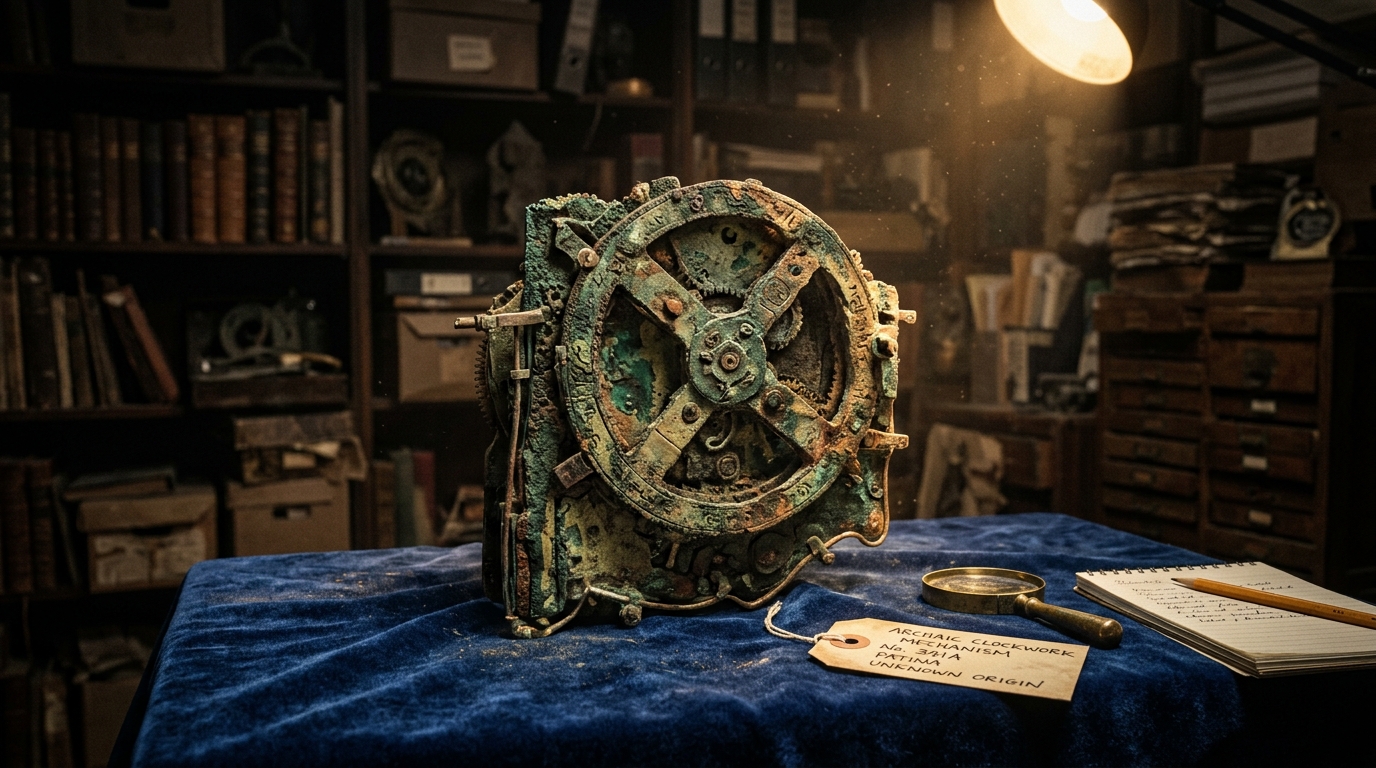
Yes, a select few. The most famous example is the Antikythera Mechanism. Initially met with extreme skepticism because of its complexity, rigorous X-ray and CT scanning over decades eventually convinced the scientific community of its authenticity. It is now widely accepted as an ancient Greek analog computer, proving that ancient technology in certain fields was far more advanced than previously believed. However, the majority of OOPArts are largely dismissed as hoaxes or misinterpretations.
Radiocarbon dating can only be used on organic materials (things that were once alive, like wood, bone, or leather) that are up to about 50,000 years old. Many controversial artifacts are made of stone, metal, or fired clay, which cannot be directly carbon-dated. Scientists must instead try to date organic material found directly attached to or in the immediate sedimentary layer surrounding the object, which leads to disputes about whether the object and the dated material were deposited at the same time.